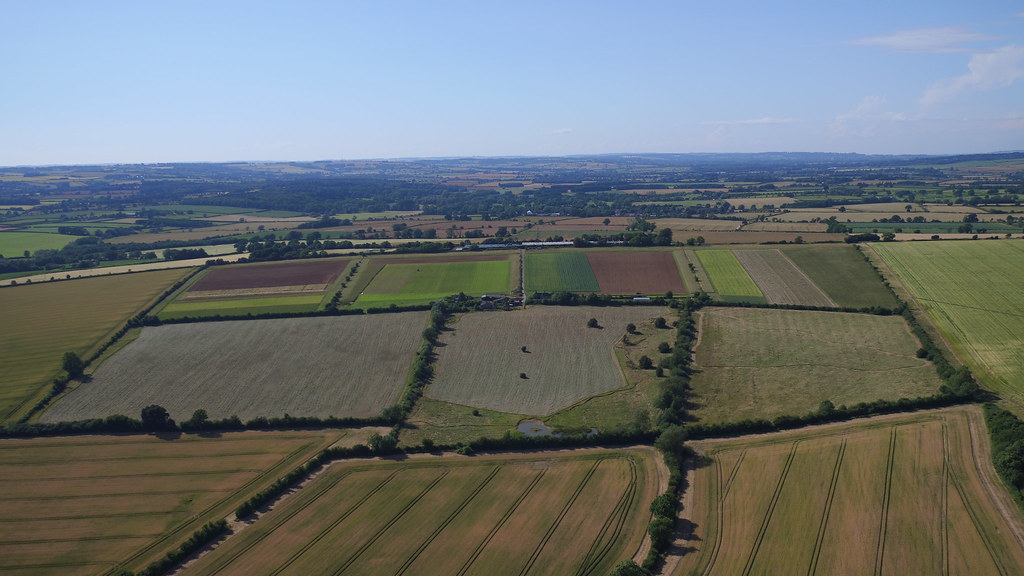
Although the development of Honeydale as a Centre for Farming and Food is in its preliminary stages and as yet we have no buildings and facilities to host events, we’ve made great progress with the farm itself, and we’re already welcoming visitors who are keen to see the work we are doing on the land.
This week Ian led a workshop for the National Trust farm team and tenant farmers from all over the UK. Delegates came from as far afield as Devon, Somerset, Wiltshire and Wales in order to get a better understanding of using diverse leys, herbal leys and mob-grazing, particularly in relation to sheep.

The farm walk and talk explored the health of the farm from the soil up, beginning with an exploration of the importance of managing the soil for fertility, before looking at establishing the ley. Grazing management, electric fencing, water, crop rotation and integrating plants, livestock and wildlife were also covered.
Finally, we found, clipped and marked the elusive queen in our healthy WBC hive. She has been playing very hard to get! She's laying eggs and looking healthy, but the laying has slowed down now that summer is at an end. The national hive is also healthy and the bees are still flying well.
 |
| See if you can spot the queen in this image |
As we are approaching the end of the season now, Chris removed all of the full supers from his hives but we are a bit disappointed with honey yield. The bees have been feeding on it during the changeable weather over the last few weeks. Chris says it’s also likely that they’ve been finding it hard to draw out honeycomb on the frames. We'll have an accurate idea of yield once the honey has been extracted.

We took a super off each of our hives (both the WBC and national) which will be stored and extracted in due course but we have left some supers on both hives in the hope that we might get a final flush over the next few weeks if the weather is favourable.
As part of our 8 year rotation at Honeydale, we have a large wild bird plot which contains lots of sunflowers. As you can see from the photo, these are now all coming into flower which is great because the bees love them. It will be plants like this that will contribute to any late honey-flow if we get one and the weather behaves itself!
Work has started on re-locating the entrance to Honeydale, with one of the first tasks being building a stone wall along the roadside. As you can see from the image the project is coming along nicely. We will keep you updated with further progress.
At Paul’s inspection this week, the surviving WBC was observed to be doing well, with lots of eggs and brood present. He still couldn't find the queen but the quantity of visible eggs prove that she must be in there somewhere. The bees have almost filled their second super so a third has been added. As you can see from the photo, it’s looking very tall!
It’s nicely balanced in size by the national hive which is also performing so well that it has received a third super too. Plenty of eggs and brood were present in this hive, and the queen was easy to spot here, which is great.
We now appear to have a colony of wasps in WBC2. We thought we had sealed up the hive after the bee colony had been lost to wasps, but the invaders have been managing to squeeze in and out of the breather holes at the top of the hive. To combat this Paul has sealed up the holes and put out some wasp traps, so hopefully this nest will die off and we can get it emptied and sterilised, ready for a new bee colony.
This is our only troublesome hive, and the good news is that all of the others are busy and there were lots of bees out and about taking advantage of the good weather.
This weekend we took advantage of a break in the weather and combined our control plots of spring barley. Since we took over Honeydale four years ago, we have conventionally farmed the two plots totalling 4.6 acres in just the same way they had been managed for decades by the previous owners.

We were delayed slightly by a flat tyre and a slipping belt on the combine, but after we inflated the tyre and re-tensioned the belt we were off. It took us three hours to get the crop in, and it’s now gone to the Adams farm as we have no way of processing it, yet. We have a perennial sowthistle problem in the spring barley plots, which restricts the yield. We harvested 4.5 tons, so about a ton per acre, which is not great, considering the cost of inputs - we used 2 herbicides, broadleaf and graminicide, nitrogen fertiliser and a fungicide.
Away from these control plots, we’re using the time honoured low input/low risk method of farming, and are keeping detailed records of the results to make a proper comparison. Watch this space.
As part of our eight year rotation, we sowed stubble turnips and forage rape for the sheep to graze on over winter, once the grass in the ley has stopped growing. It will also prepare the way for spring wheat which will be sown next spring.
As we found the crop a bit lacking last year we also mixed in some crimson clover to add nitrogen to the soil and to provide a higher protein content in the forage. This is not standard practice but as we are still building soil fertility we’re making use of any opportunity to put in soil improving legumes.
We are still experimenting with the shallow plough but it didn’t work too well, as it wasn’t inverting the old ley, so we had to use the conventional deep plough on this occasion. But we’ll keep persevering with the shallow plough until we perfect the technique.