.png)

Bee-fore and After!
Full inspections of the bees will start again next month, when the weather has warmed up a little more. In the meantime we checked the winter food stores again this weekend, beginning with the trio of Honeydale hives. One of these colonies has used up all the fondant while the second hive has only used a fraction, so we shared out the remainder between the two to last them both until the bees can go out and about collecting their own food supply. The third hive, being a recent addition, still has plenty of stores of its own.

Moving on to Chris’s hives, our task this week was to prepare for the arrival of five additional hives which will be arriving at Honeydale in a few weeks time. With the help of new recruit, Dan, the bases were rearranged so that they are in place for Chris to sit the new hives. Luckily each base is large enough to accommodate two hives so we don’t need to bring in any more of them.
Over the past week, Bernie has been refurbishing one of the spare hives which were donated to us at the end of last year. It has scrubbed up nicely and they’re all going to look very attractive when they’re given a fresh coat of ‘Honeydale White’ paint. Once the paint has thoroughly dried on the first refurbished hive, the colony of bees in the older Honeydale hive will be transferred to it so that Bernie can then set to work refurbishing their current hive.
Digging The Dirt on Honeydale Farm
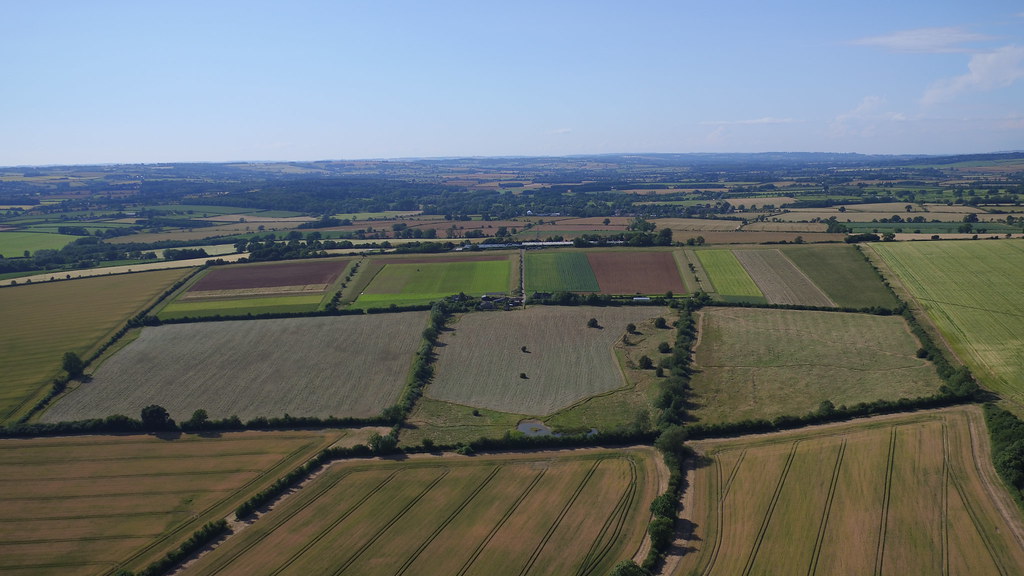
Digging the Dirt is a Soil Association series of in-depth reports on farmers who are reaping the benefits of investing in their soil. (by Tim Bevan)Cotswold Seeds purchased the 107 acre Honeydale Farm back in 2013. Managing Director, Ian Wilkinson, wants to demonstrate how small family farms can use sustainable farming practices whilst maintaining a respectable income. The single most important factor in achieving this goal is improving and maintaining soil quality of their Cotswold brash soils.
Setting a baseline
For the first year, Ian ran the farm exactly as it had been run by the previous owner. With half the farm down to arable and half as ridge and furrow permanent pasture. Ian drilled 60 acres of spring barley. All operations were carried out by contractors and produced a good quality crop, which received a malting premium. This looked promising until the sums came in. The total cost for crop establishment, fertilisers and sprays came to £11,000 which was £60 more than the crop returned.The crop was only in the ground for 12 weeks, so for much of the year there was little soil cover leaving it exposed to runoff. So on consideration the existing system did not meet any of the farm’s ambitions. Historically, the farm had been profitable but this was due to lower costs, good grain sales and support payments; both stewardship and area payments. The permanent pasture produced some income from hay sales, grazing lets and a stewardship payment.
Carrying on with this simple system was not an option; motivation to change came from a desire to put in place a truly sustainable farming system which would:
1. Produce high quality food
2. Increase farm diversity
3. Improve economic performance
Diversity for resilience
Diversity of farm structure is important to improve the farm business performance by having a range of produce for sale and to reduce exposure to limited markets. Direct farm payments are still important to the farm income, but the intended changes to the previous simple system will create new income streams and so support payments will not be relied on in the future. The farm is to be made as diverse as possible with a ‘patchwork quilt of cropping’ – to quote Ian.
The 5 stages of Honeydale’s 8 year rotation
The rotation will not be rigid as some degree of flexibility is essential for changing circumstance and un-expected weather conditions. This flexibility is provided by the farm owning much of its own machinery and equipment – this was made possible by purchasing second hand, smaller machinery to keep down costs with the exception being one modern tractor. Ian’s planned rotation is:
1. Mob grazing & herbal ley for soil improvement
The soil improvements have started by putting in place an 8 year rotation at Honeydale with a 4 year deep rooting herbal ley (a standard Cotswold seed mix) at its heart. This ley, once established, is managed by a sheep flock in a mob grazing system. The livestock are fundamental to the system, transferring fertility from their manure and urine to the soil. The sheep are not owned by Honeydale Farm, in fact there is no intention to own livestock, as this will be too much of a time commitment as well as an unwanted capital purchase. The only input from the farm staff is watering and moving to fresh grazing.

At the end of its 4 years, the ley is ploughed under, typically at the end of July. A crop of stubble turnips and forage rape are sown to be grazed by ewes with lambs at foot. This forage crop allows for effective destruction of the ley. Although ploughing is known to have a negative effect on soil health, the options to kill off a well-established sward are limited. To reduce the soil damage the farm has invested in a new very shallow plough; an ‘Ovlac’ from Spain, a 6 furrow reversible with which it is possible to plough at only 3-4 inches. This forage crop is grazed by sheep and this typically lasts into January. The remaining grazed stubble is ploughed under with the shallow plough and sown with spring wheat, at a standard seed rate.
3. Undersowing & direct drilling for weed suppression
Although not managed organically, Ian wants to eliminate pesticide use, so to help with weed control, the wheat is under-sown with a mix of white clover and yellow trefoil. This is sown on the same day as the wheat with the farm’s own Aitchson seed drill; a typical coulter type drill The drill places the clover/trefoil seed between the drills of the wheat seed. The clover and trefoil mix is not just for weed suppression but also for soil health – as much soil is covered with a plant as possible throughout the year. Bare soil is frowned upon at Honeydale, as there is now considerable evidence that for a soil to function at its best it needs to interact with a living plant root as well as to be fed with good quality organic matter.
Both the white clover and yellow trefoil do not compete with the wheat crop, and once the wheat is harvested there is a crop ‘ready to go’ for grazing the sheep. Incidentally, there is long history of using yellow trefoil in the UK, particularly with spring barley where the two crops were grown together in a continuous rotation.
Although the clover and trefoil is available for autumn grazing it is kept back for early spring grazing by the sheep.
If grazed hard by the sheep in the spring, the farm will experiment with sowing a spring oat crop directly into the clover and trefoil stubble, with a March or April sowing date. If this is not possible, the stubble will be shallow ploughed and the oats under-sown with vetch. The oats are cut in August, with the under-sown crop of either clover/trefoil or vetch going on as a winter cover crop, which is available for spring grazing.
4. Seed mix for wildlife and soil improvement
A wild bird seed mix is slotted into the rotation next, with an emphasis on late spring mechanical weed control to prevent problem weeds getting into the rotation. The mix is a field scale wild bird seed mix, sown annually in the early summer. It is shallow drilled and rolled and left down for a year, then moved to a different field. The aim is to provide food for the birds and also to act as a green manure and soil improver.
5. Nurse cropping for re-establishing grass ley
To complete the rotation, the diverse grass ley is re-established. Honeydale is experimenting with methods to do this and to suppress weeds; typically the ley would be under-sown beneath a spring cereal crop, but this year Honeydale used buckwheat, sown at 18kgs per acre as a nurse crop to protect the under-sown ley from summer heat and sun and to give good soil cover. The frost in November killed the buckwheat and left the new ley.
The bottom line
At the start it was clear the old regime wasn’t working financially, so how will the new model change this?
New crops
Adding value to crops will help, but is proving challenging so far. Ian has looked at ways to turn 5 tonnes of oats into a product he can sell directly for making porridge; this has been more difficult than he first thought. Big processing facilities do not want small quantities and the cost and equipment to process what is a small tonnage of oats is so far preventing this project from progressing.
15 acres of the farm has been planted as fruit orchard, helped by a local nurseryman and the local community, with mostly apple, pear and cherry trees in single varieties. They are planted at a traditional spacing of 30 foot, to allow for sheep grazing between the trees. This increases productivity by having two crops from the same plot of land, as well as the sheep being able to return fertility to the orchard soils. Ways of adding value to the fruit will be considered, such as bottling the fruit for direct sales.
A rural community hub
Ian considers the farm buildings important in his ambitions to improve earned income. He has plans to make this a centre for the wider rural community by providing a processing centre to add value to farm produce – in fact he would like to see it as a complete centre for the processing, distribution and sales of local farm produce. The general and local public are already interested in what the farm is doing turning up in high numbers to farm open days.
Flood management & planting trees
Soil health and water quality go hand in hand, but a natural flood management scheme at Honeydale has used innovative techniques to help reduce flooding from rapid storm run-off in the local village of Ascott-under-Wychwood. There is spring line on the farm, which feeds the Evenlode River via two main streams. The river rises and falls very quickly.In 2010 it flooded 60 homes in Ascott-under-Wychwood. All the land at Honeydale is on a slope and the streams had been straightened so water run off to the river was too efficient.
A new system was devised with the help of an aquatic consultant. The straightened stream was put back into its original sinuous bed still visible on the landscape and the water flow was held up further by the use of three ‘leaky’ dams. These are stone faced earth wall bunds with a leaky or permeable top, constructed from large stones, which are covered with turf to hide the landscape work. The water is then fed into a large scrape and wetland before reaching the Evenlode. This wetland area is planted up in a dense pattern with a mixture of hazels, willows and dogwoods to encourage water infiltration deep down into the soil. The net result is a flattening out of the peak water flow.
This scheme was supported by the Cotswold Rivers Trust and the Big Lottery Fund ‘Awards for All’ for capital works and tree planting. Not surprisingly, this scheme has attracted great interest from water companies and politicians.
Honey and pollination
To encourage diversity, the farm has recently installed seven beehives, with help and advice from Cotswold Bees. Not only will they provide income from honey sales, but they will also help pollinate seed crops and fruit trees. The first honey is from bees collecting nectar from a crop of Sainfoin; a long term crop used on the farm, which is down for 7-8 years and is very important as a soil improver.
Measurement and results
An experimental area on the farm has been invested in with monitoring equipment by North Wyke, Reading University and the Duchy College. The research focuses on the deep rooting mixtures important to the farm’s underlying philosophy, with interests in forage quality, nitrogen losses, and total emissions.
It’s still early days for the soil improvement measures so soil analyses are still base line references; soil organic matter measured by Loss on Ignition is at 4% sampled from soils in winter stubbles, potash levels are at a respectable 2 and phosphate levels quite high at 3 - certainly for the Cotswold brash soil type. As a control measure to compare against his present system, Ian has kept a total of 5 acres under the original ‘spring barley only’ system.
There are no additions from outside the farm system, either of purchased manures or composts – the manure from grazing sheep is the only, but very valuable input.
Early indicators
The advantages of the changes are already becoming evident – there is less sign of the soil erosion that used to build up in the farmyard and run down the drive. The grazing of the grass leys is effective in controlling troublesome weeds such as perennial sow thistle, which is grazed off before it gets chance to seed.
Permanent pasture is highly valued on the farm for its multiple benefits, so these have been preserved from the original farming system. They provide grazing in the shoulder months, a valuable hay crop and also native wild flowers, which are becoming rare in the countryside with the knock-on loss of their supporting role for our native insect pollinators.
The farm strives to be an example of how to produce food, care for wildlife, manage natural capital, maintain the landscape and protect human welfare; here, there are multiple outcomes from the same parcel of land. To quote Ian he hopes it to be ‘a new version of the mixed farm’.
Intercropping Oats
It was a wet but busy weekend at Honeydale. Last year we under sowed wheat with a yellow trefoil and white clover winter cover crop, and this year we’ve direct drilled spring oats into the yellow trefoil and white clover. We’re now been topping it with mob-grazed sheep which works on two levels, saving us from having to roll it and also adding fertility to the land through the sheep’s dung. It’s the first time these fields have had livestock on them for decades so we’re looking forward to seeing an improvement.


Keep Feeding The Birds
With spring rapidly springing, our bird expert Richard Broughton came to conduct a survey at Honeydale last week to check up on how the winter feeding programme is going and he counted a flock of 60 finches/buntings (mostly Yellowhammers and Chaffinches) on the feeding area. Interestingly, as in last month’s survey, the birds were almost exclusively concentrated here, proving the importance of our programme of broadcasting bird feed throughout the hungry gap. It’s clearly continuing to support large numbers of birds right up to the end of winter.

On the other hand, the sown (unfed) plots are now totally barren, so we are planning to continue the winter bird feeding programme well into May, when there should be be enough new growth on the sown plots to provide alternative sources of food.
Richard also sighted a Sparrowhawk, Raven, Kite and noisy Kestrel in the area, which may have their beady eyes on the owl box or the old crow nest in the tall ash tree and we’re delighted to welcome Chiffchaffs, the first of the summer migrants to arrive on the farm.
Storm Doris Raises the Roof...
...off one of the Honeydale bee hives! We carried out an inspection on the farm the day after the storm and the top of the National hive, which was recently relocated to the farm, was laying on the ground. The bees were exiting through the top. Doris had also taken down one of the hazel hurdles that shelters the apiary, leaving this particular hive unprotected. It stands higher than the other Nationals and the roof wasn’t strapped down, as is the case with the original Honeydale hives, so it became a sitting target. The roof has now been put back in place and we’re hoping the bees weren’t too distressed. We’ll know more when Paul carries out a full inspection next week.
Bird Numbers Soaring
The bird species count at Honeydale is rising. Elliot is still supplementary feeding with 10kg of seed every day, and this week he spotted a woodcock, a native farmland bird which likes wet and semi-wooded land, and has never been seen at the farm before. It’s presence takes the tally of bird species at Honeydale up to a pleasing 73.
 |
| Song Thrush |
Other native farmland birds currently residing at Honeydale include a small flock of meadow pipits in the wildflower meadow. The resident stonechat which has made a home at the top of the farm has now been joined by three pairs which can regularly be spotted by the lake. And heard too. Their distinctive call, does indeed sound like two stones knocking together and ‘chattering’. The large numbers of song thrushes are more melodious. We’re not sure if these are residents or migrants but other migrants are now definitely on the move. We had several hundred fieldfares overwintering at Honeydale but numbers of these have now dwindled as they head back to Scandinavia. There are lots of bullfinches, bold little birds which cheekily came too close for Elliot to photograph! (He only had a zoom lens with him.) Yellowhammers, goldfinches and chaffinches are regularly feeding on the plots and Blue tits, Great Tits, Robins and Blackbirds are feasting on the tree feeders on a daily basis.
 |
| Meadow Pipit |
 |
| Stonechat |
How to Prune a Heritage Orchard
We learned how to prune the Honeydale Heritage Orchard last week.Last year Andy Howard from the Heritage Fruit Tree Company near Banbury hand-grafted dozens of regional species so that we had 250 trees to plant, including 144 apples, 35 cherries, plus apricot, damson, gage, mulberry, nectarine, peach, pear, plum, quince and nectarine, and he was happy to come back to Honeydale to teach us how to prune them.

He began by telling us how a tree grows. This is vertically, via a leading tip, which releases growth hormone saying ‘reach for the sky,’ as Andy puts it. Fruit however, grows on the horizontal, so there are two types of bud on a tree. A growth bud is thinner and pointier, tends to be found on wood that’s a year old, and has faster vertical sap. A fruit bud is fatter, plumper and rounder and is found on 2 year old wood and produces slower sapped horizontal wood. Growth buds grow in a corkscrew position whereas fruit buds grow on small side branches or spurs.

Our trees are still in the formative stage, so require formative pruning, which involves making the shape of the tree that it will become when you start off with a maiden (a straight upward growth tree that's 1 year old that has been grafted and then had a full growing season.) From a maiden, via pruning, you can make a bush, ½ standard or standard, or cordons, espaliers, pyramids or ballerinas. It’s all in the pruning. The leader needs to be pruned 2 foot from the ground in the first winter, 4ft in the second for a ½ standard and 6 foot in the second winter for a standard.

With five of us working flat out we had most of the apples checked and pruned by lunchtime. We will revisit the other species in May.
Not So Busy Bees
Our midwinter check on the Honeydale bees revealed that all the hives are looking very healthy, with nothing to cause any concern.

We’ve provided all the hives with sugar fondant to be on the safe side, but the bees performed well in the summer, building up their honey stores which are still plentiful and might have been sufficient to see the bees through until they can replenish their food supplies in spring.
The behaviour of bees in winter is slow and sluggish. They keep a tidy house inside the hive, clustering together in a ball formation and taking it in turns to move to the warmer centre, much as Antarctic penguins do. They’re also popping outside for short toilet trips and forays for water.

Over the next few weeks we’ll be doing a bit of our own housekeeping too, in preparation for spring, cleaning out one of the hives that was recently donated to us. This involved blowtorching it to sterilize before the newly arrived colony is transferred into it in the Spring and the hive they are currently occupying will then be given a refurb too.
We’ll continue to check on the bees as winter progresses and we move towards spring.
Honeydale’s Fellowship of the Ring
If you’ve been following the Honeydale blog you’ll know that Elliot has been feeding the birds at Honeydale as part of the Supplementary Winter Bird Feeding project. This involves broadcasting the seed across the field by hand, and the very first time Elliot did this, on a frosty December day, he threw out more than a handful of seed!
It wasn’t until he returned to the Cotswold Seeds warehouse, where he is Manager, that he realised he was no longer wearing his wedding ring. Elliot hadn’t been wearing any gloves when he spread the seed, and the icy conditions meant that the ring had been looser on his finger than usual, so he thought it likely that the ring had been lost on the farm. Elliot and his wife Harriet had celebrated their sixth wedding anniversary just the day before, so both were upset by the loss of Elliot’s band of gold and several friends and colleagues went back to the plot at Honeydale to have a hunt. The remains of the wild bird seed mix that had been sown in the spring is now all used up and patchy, with bare soil showing between the plants - which is the whole reason for carrying out the supplementary bird feeding in the first place. So hopes were high that the ring would not be too hard to find. But no luck. Until Warehouse Assistant Del came to the rescue! He contacted a friend of his, John Miller, scaffolder by trade, and also founder of the metal-detecting Recovery Service.

John arrived at Honeydale after the Christmas break and within half an hour he texted Elliot with a photograph of a ring he had discovered, lying partially concealed in the remains of the fodder radish, quinoa, millet, linseed and mustard, pretty much impossible to spot with the naked eye, but easy to find if you have the right tools.

This is in fact the second ring John had been asked to find on a farm. Earlier last year a local farmer lost his wedding ring during lambing and John was tasked with finding, not quite a needle in a haystack, but a ring in a big barn full of straw.
Subscribe to:
Posts (Atom)
HONEYDALE FARM
Centre for diverse farming in the Cotswolds.


